jev-playwright
Using this package? Please consider donating to support my open source work ❤️
Help jev-playwright grow! Star and share this amazing repository with your friends and co-workers!
Jev Playwright
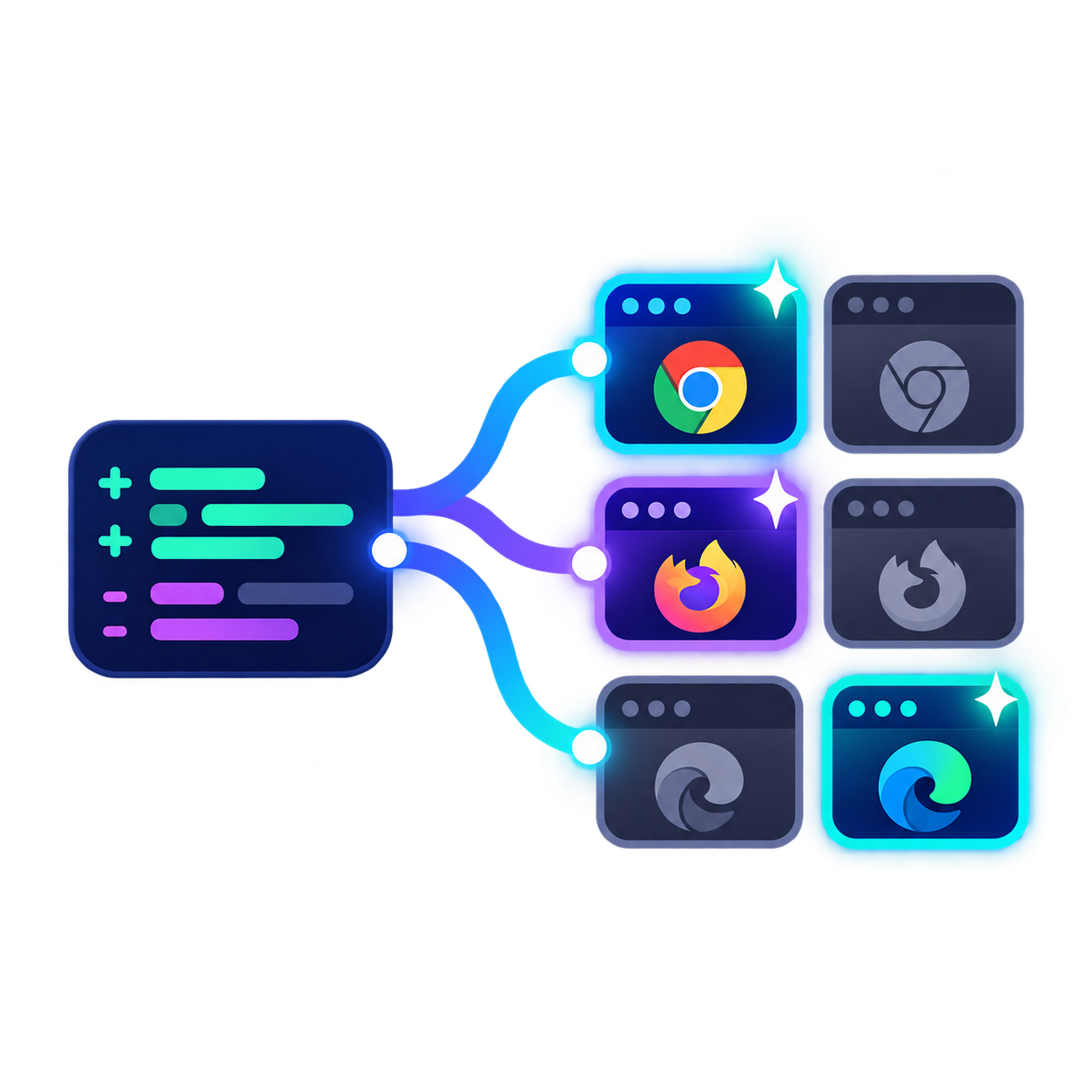
Run the Playwright tests relevant to a code change. Add one reporter; it uses Jev, TypeSafe’s model for typed yes/no decisions, to select existing tests before they run.
Package-aware tools such as Turborepo and Nx can scope unit tests using the changed-package graph. E2E tests are harder: a single browser journey can cross many packages, pages, and services. jev-playwright compares the change with Playwright’s discovered tests to select relevant journeys before browser execution, reducing test runtime in large CI suites.
[!WARNING] This is a relevance filter, not a guarantee that every affected test will run. Its goal is to skip many clearly unrelated tests while keeping plausibly affected ones; it can still miss tests. Keep full-suite coverage where completeness matters.
Requirements: Node.js 24.16+ (declared by this package) and Playwright 1.62+ (required for reporter preprocess()). Get started · Choose an AI provider · Use it in CI · Configuration reference
Get started
-
Install the package in a project that uses Playwright:
pnpm add -D jev-playwright @playwright/test -
Set a TypeSafe API key:
export JEV_PLAYWRIGHT_PROVIDER_KEY="your-typesafe-key"Using OpenRouter instead? See OpenRouter setup.
What leaves your machine: Jev receives changed paths, git patches, test titles, and test callback bodies/comments by default. PR or commit descriptions may also be sent. Secrets in diffs or test source are not redacted. Filter sensitive changed paths with
include/exclude; setincludeTestSource: falseif test bodies should stay local. -
Add the reporter to
playwright.config.ts:import { defineConfigWithJev } from 'jev-playwright'; export default defineConfigWithJev( { enabled: true }, { testDir: './e2e', reporter: [['list']] } ); -
Change a file and run your usual command:
pnpm exec playwright test
defineConfigWithJev(jevOptions, playwrightConfig) keeps your Playwright settings and other reporters. For CI-only selection, use { enabled: process.env.CI === 'true' || process.env.CI === '1' } instead of enabled: true.
A green run can execute zero E2E tests. If Jev selects none, Playwright reports them as skipped and can exit successfully. Check the
Selected 0/N testsmessage. Compare selections with full-suite results before relying on them for required CI checks. If selection fails or no included changes are found, the reporter runs all tests.
How selection works
Playwright discovers tests first, respecting your project and test filters. Then the reporter:
- Reads staged, unstaged, and untracked changes locally, or chooses a CI baseline.
- Always includes directly changed specs. Jev scores the remaining tests against the change using their titles and file paths.
- Runs tests at or above
threshold(default0.5). If selection cannot be completed, it runs the full suite.
Each score is Jev’s estimated probability that the change could affect that test’s behavior or setup. TypeSafe describes these probabilities as calibrated in aggregate, but a score is not the probability that a test will fail or a guarantee that other tests cannot be affected. Start with the default threshold, compare selections against full-suite results for your own changes, then tune it. A higher threshold runs fewer tests but increases the chance of missing one.
Control what Jev sees
Include test source (optional)
Test bodies and immediately preceding comments are sent by default to help Jev judge assertions and POM calls. Set includeTestSource: false to send only test titles and paths. Each excerpt is limited to 5,000 JavaScript lexical tokens (and 15,000 characters). If source is unavailable, the test remains a candidate using its title and path. POM implementations are not included.
By default, the same test in multiple Playwright projects shares one decision. Set perProject: true when Chromium, Firefox, or WebKit could need different selections.
export default defineConfigWithJev(
  {
    enabled: true,
    include: ['src/**', 'e2e/**'],
    exclude: ['src/generated/**'],
    includeTestSource: true,
    threshold: 0.6
  },
  { reporter: [['list']] }
);
Filter changed files
include and exclude match repository-relative changed paths, not test titles. Exclusions win, but a directly changed spec still runs. For example, with exclude: ['docs/**'], a change to docs/README.md and e2e/login.spec.ts still runs the changed login spec. If every changed path is excluded, the full suite runs. Only exclude Markdown when it cannot affect your app; documentation sites may render it.
Exclude generated files
excludeGeneratedFiles defaults to true. Mark files whose generated content should not influence test selection in your repository’s .gitattributes:
pnpm-lock.yaml    linguist-generated=true
src/generated/**  linguist-generated=true
Git reads the attribute, including rules in nested .gitattributes files. Marked files remain in the changed-file inventory, which the reporter uses to identify directly changed specs and decide whether it has usable changes. Their paths and patches are excluded from the input sent to Jev. A changed spec still runs; if only generated files changed, the full suite runs. Set excludeGeneratedFiles: false (or JEV_PLAYWRIGHT_EXCLUDE_GENERATED_FILES=false) to include their diffs.
The attribute lookup happens when getGitChanges() reads the repository. If you supply your own Changes object to selectTests(), filter its diff and patches yourself.
The same linguist-generated attribute tells GitHub to hide generated files in diff views. Other Git hosts may present those files differently; selection uses Git’s attributes, not a provider API.
Preserve whitespace changes
Git ignores whitespace-only changes by default. To preserve whitespace changes in the patch Jev sees, set whitespace: 'none':
export default defineConfigWithJev(
  {
    enabled: true,
    diff: {
      whitespace: 'none',
      ignoreBlankLines: false,
      contextLines: 3
    }
  },
  { reporter: 'list' }
);
diff.whitespace controls what Git ignores. The default 'all' ignores whitespace-only changes; 'change' ignores differences in the amount of whitespace; 'eol' ignores end-of-line whitespace; 'none' preserves all whitespace changes. Use 'none' for CSS, HTML, or templates where spacing can matter. Changed-file detection and directly changed specs are unaffected.
Smart diff selection
Jev sees changed files, their add/modify/delete/rename status, and the git patch. Each test question includes its title, relative path, and optional source body. Available PR title and description provide additional context; otherwise CI can use the commit message. Set prTitle or prDescription to override those hints.
Descriptions are converted to plain text and limited to 2,000 characters; titles are limited to 200. This cleanup affects only the hint, not the patch.
| Change | Context sent to Jev |
|---|---|
| Patch fits | All changed paths and the full patch are sent together. |
| Patch exceeds the request budget | Every file’s patch is evaluated in chunks. A test runs if any chunk finds it relevant. |
| Only discovered specs changed | No Jev call; those specs run directly. |
One file’s patch cannot fit, a request fails, or limits.maxRequests is reached |
Full discovered suite runs. |
For a large change, the selector takes each test’s highest score across chunks and compares it with threshold. For example, if the checkout chunk finds a test relevant but the billing chunk does not, that test still runs. No tests run only if every required chunk was evaluated successfully and none found a relevant test. Programmatic callers supplying an oversized diff must also supply per-file patches; otherwise the full suite runs.
Request limits
TypeSafe documents two input budgets: 32k tokens for the shared change state plus the longest test question, and 64k tokens for the state plus all questions in one request. The selector sizes requests conservatively using UTF-8 bytes, which can split them earlier than Jev requires.
limits.requestTokens controls when tests or file patches are split. limits.maxRequests defaults to 100 across the entire selection; exceeding it runs the full suite. At most five requests run concurrently by default (limits.maxConcurrentRequests). OpenRouter documents a 32k total context, so set limits.requestTokens: 32000 there. beforeRequest hooks may run concurrently.
Outcomes and fallbacks
| Outcome | What Playwright does |
|---|---|
| Some tests selected | Runs them, plus any directly changed specs. |
| Complete selection finds no relevant tests | Marks tests as skipped; the command can exit 0 without running an E2E test. |
| No usable changes, missing git baseline, oversized single patch, provider failure, or incomplete answer | Runs the full discovered suite. |
Look for Selected N/M tests or Running all tests: <reason> in the reporter output. To assess missed coverage, compare selections with full-suite runs before making a reduced run a required CI check.
Choose an AI provider
TypeSafe (default)
Only the key is required. The package uses @typesafe-ai/sdk directly, with its default API URL and the jev-latest model:
export JEV_PLAYWRIGHT_PROVIDER_KEY="your-typesafe-key"
The SDK’s native TYPESAFE_API_KEY and TYPESAFE_BASE_URL variables also work when the corresponding JEV_PLAYWRIGHT_* values are unset.
OpenRouter
Point the same TypeSafe SDK at OpenRouter’s System One endpoint:
export JEV_PLAYWRIGHT_PROVIDER_URL="https://openrouter.ai/api"
export JEV_PLAYWRIGHT_PROVIDER_KEY="your-openrouter-key"
export JEV_PLAYWRIGHT_MODEL="jev-1.13"
export JEV_PLAYWRIGHT_LIMITS_REQUEST_TOKENS=32000
The SDK appends /v1/systemone to the URL. jev-1.13 is a documented OpenRouter-supported model ID. The SDK default jev-latest also works on OpenRouter but can move between releases, so pin the model if you tune threshold. OpenRouter documents a 32k total context, which is why the example lowers limits.requestTokens; adjust it if your provider has a different budget. See OpenRouter’s TypeSafe SDK guide.
Custom authentication or transport
Pass a configured SDK client if your provider needs custom headers, a fetch implementation, or other SDK settings:
import { TypeSafeClient } from '@typesafe-ai/sdk';
import { defineConfigWithJev } from 'jev-playwright';

export default defineConfigWithJev(
  {
    enabled: true,
    client: new TypeSafeClient({
      apiKey: process.env.MY_JEV_KEY,
      baseURL: process.env.MY_JEV_URL
    })
  },
  { reporter: 'list' }
);
client takes precedence over providerKey and providerUrl. The client must implement the TypeSafe SDK’s systemOne() method.
Use it in CI
With no explicit baseRef, the reporter uses CI environment variables and local event data to choose what to compare with HEAD. It makes no CI-provider API calls and never fetches git history.
| Run | Baseline | If unavailable |
|---|---|---|
| Local | Staged, unstaged, and untracked changes | Full suite when no included changes exist |
| Pull/merge request | Merge-base with the target branch | Full suite |
| Feature branch | Merge-base with the default branch | Full suite |
| Default-branch push on GitHub, Gitea, or GitLab | Previous push SHA, covering all pushed commits | Full suite |
| Default-branch build on Bitbucket or Azure | No previous-push SHA available automatically | Full suite unless BASE_REF is set |
| Tag or unrecognized CI run | No baseline | Full suite |
Branch comparisons need the target branch and enough history in the checkout, such as fetch-depth: 0 with GitHub Actions.
An explicit baseRef, JEV_PLAYWRIGHT_BASE_REF, or BASE_REF overrides detection. For example: BASE_REF=origin/main pnpm exec playwright test. Outside CI, no CI-provider detection runs.
GitHub Actions
`GITHUB_ACTIONS` identifies the runner. PRs use `GITHUB_BASE_REF`; feature branches use the repository's `default_branch` from `GITHUB_EVENT_PATH`. A default-branch `push` uses the event payload's `before` SHA. Without a valid previous SHA, it runs all tests.Gitea Actions
`GITEA_ACTIONS` takes precedence over GitHub's compatibility variables. PRs use `GITHUB_BASE_REF`; feature branches use the payload's `repository.default_branch`; default-branch pushes use `before` from `GITHUB_EVENT_PATH`.GitLab CI
Merge requests use `CI_MERGE_REQUEST_TARGET_BRANCH_NAME`; feature branches use `CI_DEFAULT_BRANCH`. Default-branch push pipelines use `CI_COMMIT_BEFORE_SHA`. An all-zero SHA, such as on a first or manual pipeline, triggers a full run.Bitbucket Pipelines
PRs use `BITBUCKET_PR_DESTINATION_BRANCH`; feature branches compare against the configured default branch. Bitbucket does not provide a reliable previous-push SHA as a built-in variable, so default-branch builds run all tests unless you set `BASE_REF`.Azure Pipelines
PRs use `SYSTEM_PULLREQUEST_TARGETBRANCH`; feature branches compare against the configured default branch. Azure does not provide a reliable previous-push SHA as a built-in variable, so default-branch builds run all tests unless you set `BASE_REF`.If a provider cannot supply the default branch, main is assumed. Set defaultBranch or JEV_PLAYWRIGHT_DEFAULT_BRANCH for a different branch name. Unknown CI providers, tag builds, and incomplete CI context run all tests. You can inspect the chosen baseline with await detectCiDiff(resolveConfig(options)).
Customize the decision
Use relevanceGuidance for a shared rule sent once per request, and relevanceCriteria to customize either yes/no outcome on every typed question. Use createQuestion to change the per-test instructions, or beforeRequest to add project context:
export default defineConfigWithJev(
  {
    enabled: true,
    prTitle: process.env.PR_TITLE,
    relevanceGuidance: 'Consider indirect changes through shared billing services.',
    relevanceCriteria: {
      true: 'May affect billing test setup, execution, or assertions.',
      false: 'No plausible effect on billing test setup, execution, or assertions.'
    },
    createQuestion(test, key) {
      return `Could this change affect the behavior tested by ${key} (${test.title})?`;
    },
    beforeRequest(request) {
      // Include the product area when test titles alone are ambiguous.
      return {
        ...request,
        state: { selection: request.state, product: 'billing' }
      };
    }
  },
  { reporter: [['list']] }
);
relevanceCriteria accepts partial overrides: omitted outcomes retain their defaults. Keep shared guidance concise because it is sent once per request; criteria are repeated for every test. beforeRequest may be async. Keep every test_N question or the full suite runs. Test details are appended to createQuestion output. Keep createQuestion deterministic because request sizing can call it more than once.
Use the library programmatically
When you already know the changed files and test catalog, call selectTests() without starting Playwright:
import { selectTests } from 'jev-playwright';

const selection = await selectTests({
  changes: {
    files: ['src/checkout.ts'],
    diff: '+ updated checkout behavior',
    title: 'Fix checkout'
  },
  tests: [
    {
      id: 'checkout',
      file: 'e2e/checkout.spec.ts',
      title: 'customer checks out'
    },
    {
      id: 'login',
      file: 'e2e/login.spec.ts',
      title: 'customer signs in'
    }
  ],
  config: { enabled: true }
});

console.log(
  selection.selectedIds,
  selection.assessments,
  selection.fallbackReason
);
The inputs and result have these shapes:
changes.filesis a list of repository-relative paths.diff,title, anddescriptionare optional. UsegetGitChanges(cwd, baseRef?)to gather git changes; it also returns file statuses and per-file patches for large diffs.testsis the discovered test catalog. Each entry needs a uniqueid,file, andtitle;project,source,line, andcolumnare optional.selectedIdscontains tests to run.assessmentscontains each scored test’s relevance probability and model ID.selectedIds: []withoutfallbackReasonmeans a complete decision found no tests; withfallbackReason, all test IDs are returned.
Pass client to reuse a configured TypeSafe SDK client. detectCiDiff() and resolveConfig() are also exported for custom integrations.
Inspect decisions
Run with DEBUG=jev-playwright:batch,jev-playwright:selection for compact request and combined selection summaries. Use DEBUG=jev-playwright:request to inspect the full state and question list actually sent after beforeRequest, DEBUG=jev-playwright:config for resolved options (the provider key and configured client are masked), or DEBUG=jev-playwright:* for everything. Example (abbreviated):
jev-playwright:batch request 1: candidates=68, contextBytes=8200
jev-playwright:batch request 1 result { model: 'typesafe/jev-1.13', selected: 4, total: 68 }
jev-playwright:selection selection result {
  selected: 4, excluded: 64, threshold: 0.5,
  topSelected: [{ title: 'customer checks out', location: 'e2e/checkout.spec.ts:12:3', probability: 0.91 }],
  topExcluded: [{ title: 'customer signs in', location: 'e2e/login.spec.ts:28:3', probability: 0.49 }]
}
[jev-playwright] Selected 4/68 tests
The selection result combines all batches and diff chunks, using each test’s highest score across chunks. It samples the highest 10% and lowest 5% of selected tests and the highest and lowest 5% of excluded tests (at least five from each group when available). Locations use clickable file:line:column paths relative to the configured cwd, or absolute paths for tests outside it; programmatic tests without a line show the file alone. Directly changed specs run without a score and are not included in the samples. Each question uses explicit yes/no relevance criteria. For missing test bodies, use DEBUG=jev-playwright:source,jev-playwright:test-body.
Configuration reference
Environment variables override the corresponding reporter options. Set JSON arrays for glob variables, for example JEV_PLAYWRIGHT_INCLUDE='["src/**","e2e/**"]'.
| Option | Environment variable | Default |
|---|---|---|
enabled |
JEV_PLAYWRIGHT_ENABLED (true/false or 1/0) |
false |
baseRef |
JEV_PLAYWRIGHT_BASE_REF, then BASE_REF |
CI baseline or local changes |
defaultBranch |
JEV_PLAYWRIGHT_DEFAULT_BRANCH |
provider value, then main |
cwd |
JEV_PLAYWRIGHT_CWD |
process.cwd() |
include |
JEV_PLAYWRIGHT_INCLUDE (JSON string array) |
["**/*"] |
exclude |
JEV_PLAYWRIGHT_EXCLUDE (JSON string array) |
[] |
excludeGeneratedFiles |
JEV_PLAYWRIGHT_EXCLUDE_GENERATED_FILES |
true |
threshold |
JEV_PLAYWRIGHT_THRESHOLD |
0.5 |
diff.whitespace |
JEV_PLAYWRIGHT_DIFF_WHITESPACE |
all (ignore whitespace-only changes); none preserves them |
diff.ignoreBlankLines |
JEV_PLAYWRIGHT_DIFF_IGNORE_BLANK_LINES |
false |
diff.contextLines |
JEV_PLAYWRIGHT_DIFF_CONTEXT_LINES |
3 |
limits.stateAndQuestionTokens |
JEV_PLAYWRIGHT_LIMITS_STATE_AND_QUESTION_TOKENS |
32000 |
limits.requestTokens |
JEV_PLAYWRIGHT_LIMITS_REQUEST_TOKENS |
64000 |
limits.maxRequests |
JEV_PLAYWRIGHT_LIMITS_MAX_REQUESTS |
100 |
limits.maxConcurrentRequests |
JEV_PLAYWRIGHT_LIMITS_MAX_CONCURRENT_REQUESTS |
5 |
includeTestSource |
JEV_PLAYWRIGHT_INCLUDE_TEST_SOURCE |
true |
perProject |
JEV_PLAYWRIGHT_PER_PROJECT |
false (share decisions across projects) |
relevanceGuidance, relevanceCriteria |
Playwright config only | Shared direct/indirect guidance; yes/no test relevance |
maxTestSourceTokens |
JEV_PLAYWRIGHT_MAX_TEST_SOURCE_TOKENS |
5000 (maximum 5000) |
model |
JEV_PLAYWRIGHT_MODEL |
jev-latest |
prTitle, prDescription |
JEV_PLAYWRIGHT_PR_TITLE, JEV_PLAYWRIGHT_PR_DESCRIPTION |
unset |
providerUrl, providerKey |
JEV_PLAYWRIGHT_PROVIDER_URL, JEV_PLAYWRIGHT_PROVIDER_KEY |
SDK defaults |
client, createQuestion, beforeRequest |
Playwright config only | SDK client, built-in question, no hook |
Contributing
To work on this package rather than install it in a Playwright project:
- Use Node.js 24.16+ and pnpm 12.6.0, then install dependencies with
pnpm install. - Copy the
.env.exampletemplate to.envand set a TypeSafe or OpenRouter key if you want to try a real Jev request..envis gitignored. Load it explicitly withnode --env-file=.env ...or your shell; the library does not automatically load dotenv files. Unit and Playwright fixture tests do not need a key. - Run
pnpm buildfirst. The Playwright integration fixture imports the built reporter fromdist/. - Run
pnpm test-types,pnpm test, andpnpm lint-ci.
License
MIT.